Done only counts with proof
AI is great at saying "done". Build a system where done has to prove itself.
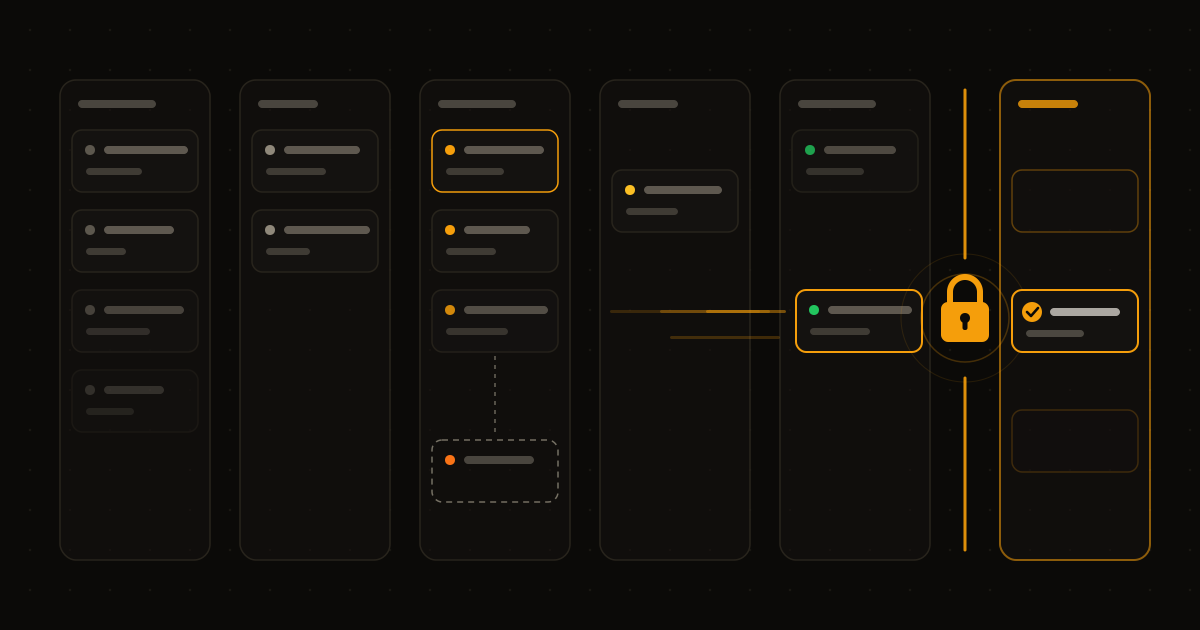
AI is great at saying "done". Fast, confident, with bullet points. And often it really is done. But "often" is a problem when production depends on it.
So I stopped asking whether it's done. I ask where the proof is. And I built two systems where nobody gets further without proof. Neither a person nor an agent.
Done is a state, not a feeling
For one piece of code, a gate that can fail is enough. A test or a real run, not a second model that nods it through. But a company isn't one piece of code. It's lots of work in progress, several people, and agents running in parallel on top.
There, a gate in one place isn't enough. The word "done" needs rules across the whole flow of work. Who holds it, what it depends on, and what must happen before it disappears from view.
Symbio: a board where Done isn't a button
I keep all work in Symbio. It's my work board. Every piece of work is one card. A card has an owner and a state. There are seven states: Captured, Ready, Doing, Parked, Final review, To ship and Done.
Sounds like any kanban. The difference is in what the server allows and what it refuses.
- Doing without an owner doesn't pass. Work nobody holds doesn't get done. It just gets talked about.
- Parked without a condition doesn't pass. When something is stuck, it has to say what will unblock it. "Waiting" isn't enough.
- Done is reachable only from To ship. And only with a recorded deployment, or with an explicit waiver saying no deployment is needed.
- Without checks ticked off, a card doesn't get to Done.
An agent can write "done" as many times as it likes. The card won't move. It moves only when there's a record that it runs where it's supposed to run. Or when a person says explicitly: this one won't be deployed.
This is what a card that really made it into Done looks like:
| Card | New form on the website |
|---|---|
| Owner | Jan |
| State | Done (from To ship) |
| Done means | An inquiry from the form arrives in the inbox. |
| Proof | Deployed, verified in the browser, link to the live page. |
| Checks | ✓ form test passed ✓ test inquiry arrived ✓ verified on a phone |
Final review is the state for a human check. But I don't use it for everything. If every card waited for me, everything would wait for me and the agents would stand still.
The rule is simple. Final review only when a person has to judge the result. Copy for a client, a decision, the look. Where a test or a deployment record decides it, I don't have to click anything. Proof is stronger than my glance at the screen.
AI will tell you "done" every time. The system has to ask for proof every time.
Error patrol: an agent that watches the servers on its own
The second system is brand new. I'm building it and moving it onto the servers. Regularly throughout the day an AI agent starts. No person at the keyboard. It goes through error logs, process status, disk and memory. It looks for what's new or getting worse. Old things it has already fixed once, it doesn't deal with again. It only checks that they haven't come back.
It groups errors by cause, not by log line. For each group it decides one of three: noise with no impact, fixed now, or it needs me.
Two lists: what it may do alone and what it only reports
An autonomous agent on production without limits is a gamble. So it has two written lists: small operational fixes it may do alone and verify right away, and everything else, which it may only report. Data, code, access and communication with people are always on the second one.
When a fix needs a code change, the agent doesn't make it. It finds the file, the line and the cause, proposes the fix in one sentence and leaves it to me. Systems that aren't mine, it only reads.
And this is where it meets the board. After every fix, the agent has to verify it works. The process runs, the endpoint responds, the error doesn't repeat in the log for two minutes. And when it doesn't know whether users saw it, it writes "impact not verified", not "no impact". The same logic as a recorded deployment.
The phone beeps only when it matters
The patrol's output is a short message in Czech, no jargon. What happened, what the agent did and what impact it had. What was just noise. And what needs me, in one sentence. When nothing new happened, it sends nothing.
Error check (afternoon)
Fixed on its own: One service crashed, came back up, verified. Impact not verified.
Just noise: the website briefly lost its connection twice and recovered on its own.
Report only: the form on the website fails on an empty field. The cause is in the code, a proposed fix is waiting for me.
This rule came from pain. Before, every error came to my chat separately. Something went down, came back a minute later, and I had another notification. It was spam and I stopped reading it. That's worse than no alert at all.
Today only what I have to react to comes to my phone. A message from a customer, a new sign-up, an inquiry. An outage only when it's longer and doesn't resolve itself, and then its recovery. Short outages, logins and deploys go to the operations overview on the board. I find them there when I look for them.
Five rules for your own done
What you can change is the system that "done" falls into.
- Give every piece of work an owner and a state. The state "it's stuck" needs a condition for what unblocks it.
- Done only with proof. A deployment record, a passed test, or an explicit exception from a person.
- Bring in a person where they have to judge. Let proof decide the rest.
- Write two lists for an autonomous agent. What it may fix alone and what it may only report. The second one matters more.
- Alerts only for what you have to react to. Otherwise you'll stop reading them.
The patrol is new, so I don't have results yet. In a month I'll write how many fixes it made on its own and how many it left to me.